
How to Find a Plan in Chess: A Practical Guide
 Ankit Rajpara
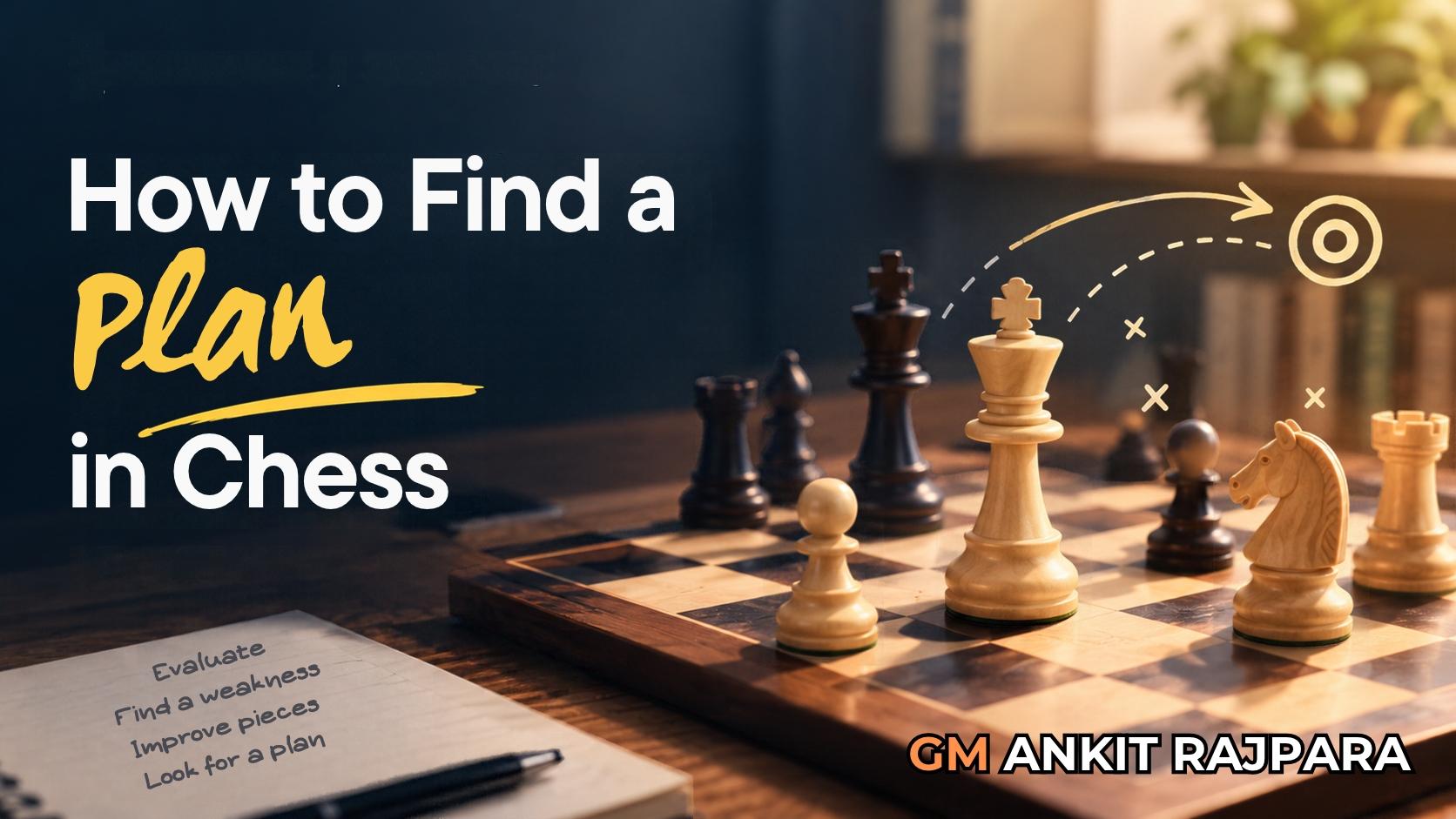
One of the most difficult moments in chess is when there is no immediate tactical opportunity and you are unsure what to do next. You may have developed your pieces and castled, but how do you decide on your next move?
The answer is to evaluate the position, identify what needs improvement, and choose a plan that helps you make progress. A good plan does not need to be complicated. It simply gives your moves a clear purpose.
1. Evaluate the Position
Before choosing a plan, take a moment to understand the position. Look at a few important factors:
King safety: Is your king safe, or are there weaknesses around it that need attention?
Piece activity: Are your pieces on useful squares? Do they control important files, diagonals, or central squares?
Pawn structure: Are there isolated pawns, doubled pawns, weak pawns, or open files that you can use?
Weak squares: Are there squares your opponent cannot easily defend or challenge?
Your plan should come from the position itself. Avoid following a fixed rule without checking whether it makes sense on the board.
2. Identify Your Opponent's Weaknesses
A useful plan often begins with finding something in your opponent's position that can be targeted. This might be an isolated pawn, a weak square, an exposed king, or a poorly placed piece.
Once you identify a weakness, consider how you can increase the pressure on it. You may need to bring another piece into the attack, control an important file, or prevent your opponent from exchanging the piece that is applying pressure.
Do not force an attack against a weakness that cannot realistically be reached. Choose a target you can put pressure on with your available pieces.
3. Improve Your Worst-Placed Piece
Sometimes the position does not offer an obvious target. In that case, a simple and effective question is: Which of my pieces is doing the least?
A knight may need a better square, a bishop may be blocked by its own pawns, or a rook may need to occupy an open file. Improving that piece can make your whole position more coordinated.
Look for a useful destination before moving the piece. The goal is not simply to move it somewhere else, but to place it where it can contribute more to your position.
4. Look for Pawn Breaks
A pawn break is a pawn advance intended to challenge the opponent's pawn structure or open lines for your pieces. A well-timed pawn break can open a file, activate a bishop, create a weakness, or give your pieces access to important squares.
However, pawn moves are often permanent decisions. Before advancing a pawn, consider which squares will become weaker, whether the opponent can close the position, and what exchanges might follow.
A pawn break is usually most effective when your pieces are ready to take advantage of the changes it creates.
5. Consider Your Opponent's Plan
Finding your own plan is important, but you should also ask what your opponent wants to do. Are they preparing a pawn break, attacking one of your weaknesses, or trying to improve a badly placed piece?
If your opponent has a strong idea, you may need to prevent it before continuing with your own plan. Sometimes the best move is not the one that improves your position immediately, but the one that limits your opponent's counterplay.
This habit helps you choose plans that are both ambitious and safe.
A Simple Checklist for Finding a Plan
When you are unsure what to do next, ask yourself these five questions:
1. Is my king safe, and are my pieces active?
2. What weaknesses can I target in my opponent's position?
3. Which of my pieces is least active, and where should it go?
4. Is there a useful pawn break or positional opportunity?
5. What is my opponent threatening or preparing?
You do not need to find a brilliant plan every time. Often, answering these questions will reveal a sensible improving move.
The Key Is to Give Your Moves a Purpose
A good chess plan is not a fixed sequence of moves that must be followed no matter what. It is a direction based on the current position. Your opponent will respond, the position will change, and you may need to adjust your plan.
The important thing is to understand why you are making a move. Instead of moving a piece just because you do not see anything better, identify what needs to improve and choose a move that helps make it happen.
The next time you feel stuck, ask yourself: What needs to improve in this position, and what can I do to make that happen?
Related Reading
Prophylaxis in Chess: How to Think About Your Opponent's Plan — Learn to recognise and prevent your opponent's ideas.
Gaining Tempo in Chess: How to Force Your Opponent to React — Understand how forcing moves can help you gain time and improve your position.
How to Choose the Right Move: A Practical Guide to Candidate Moves — Learn how to identify and compare candidate moves before committing to a decision.
Explore more chess improvement resources and grandmaster-curated training on ChessNeurons.