
How to Punish an Uncastled King: Strategic Principles & Tactics
 Ankit Rajpara
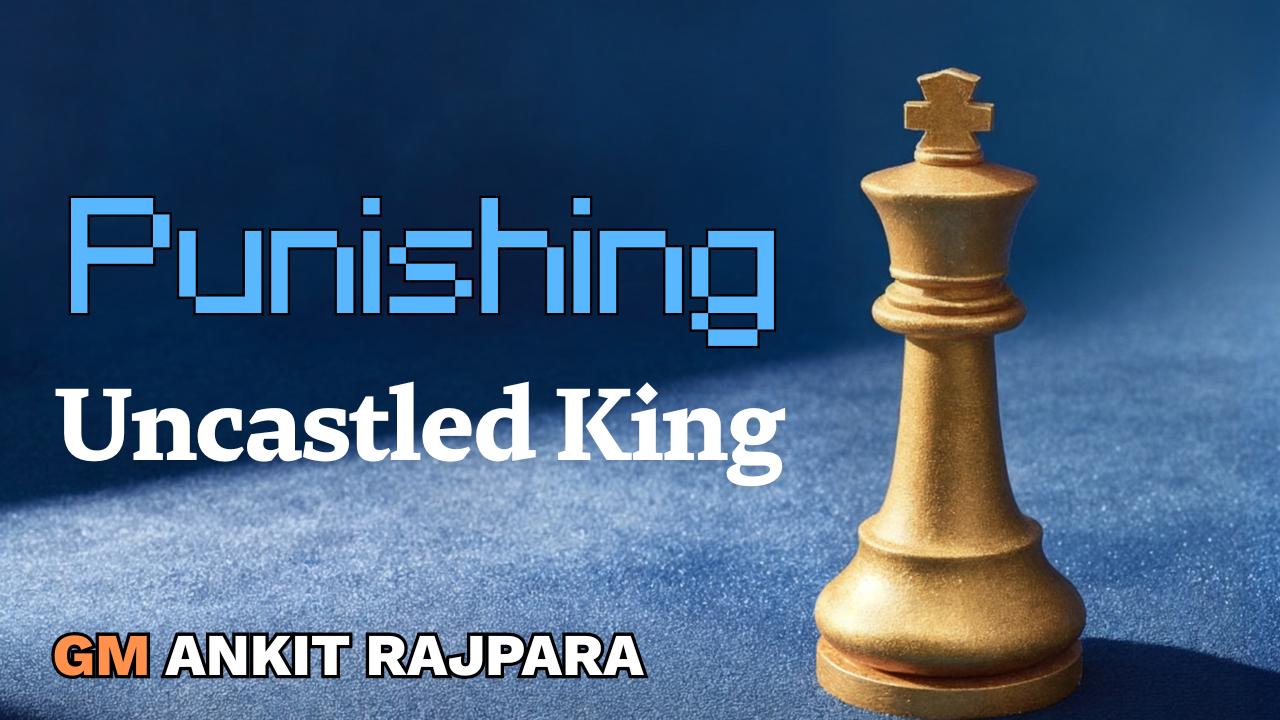
Every beginner learns the fundamental opening rule: castle early to keep your king safe and bring your rooks into play. Yet, in practical games, players frequently delay castling to chase a pawn, initiate an early flank attack, or maneuver pieces in the opening.
Leaving a king in the center is not an automatic blunder, but it creates a structural liability. When the center opens or defenders are pulled away, a centralized king becomes a target.
However, simply launching an immediate attack because your opponent hasn't castled can backfire if your own forces aren't ready. To capitalize on a delayed castling mistake, you must understand the relationship between development, initiative, and open lines.
Here is how to evaluate, prepare, and execute an attack against a king stuck in the middle.
1. When Does an Uncastled King Actually Become Vulnerable?
An uncastled king is a potential weakness, not a guaranteed loss. In closed positions where the center is locked with pawns, a king in the middle can remain safe for a long time.
A king stuck in the center becomes genuinely vulnerable when specific dynamic conditions are present:
Superior Development: You have more active pieces developed and ready for action than your opponent.
Open or Openable Center: The central files, especially the e-file and d-file, are open or can be opened through pawn breaks.
Lack of Central Defenders: Your opponent's pieces are stuck on the flanks or lack coordination around the center.
Control of Key Lines: Your rooks, bishops, and queen control files and diagonals leading toward the king.
Loss of Castling Rights: The enemy king has been forced to move, or castling would put it directly into check or danger.
"Uncastled" vs. "Vulnerable"
There is a crucial distinction between an uncastled king and a vulnerable king:
Uncastled King: A king that remains on its starting square (e1/e8) because the player chose another move. If the center is closed and defendable, this king may be perfectly safe.
Vulnerable King: A king exposed to open files, checks, and active enemy pieces, with limited escape squares and insufficient defenders.
Recognizing this difference keeps you from launching premature attacks when your opponent's position is still structurally solid.
2. Converting a Development Advantage into an Initiative
To understand how to attack an uncastled king, you must first master three foundational chess concepts:
1. Development Lead: Having more pieces brought out from their starting squares into active positions than your opponent.
2. Initiative: The ability to dictate the flow of the game by creating threats that your opponent must constantly respond to.
3. Tempo: The element of time in chess. Winning a tempo means making a useful move while forcing your opponent to waste a turn defending.
When your opponent delays castling, they spend time on other moves. To exploit this, you must convert your advantage in time into an attack before they can consolidate.
When you hold a lead in development, speed is paramount. If you play slow, quiet moves, your opponent will simply castle on their next turn and neutralize your potential advantage.
Developing your pieces with tempo—such as bringing a piece to an active square while creating a threat—keeps the pressure on and prevents the enemy king from finding safety.
3. Opening the Center and Clearing Lines
Piece activity alone is rarely enough if the enemy king is shielded by a wall of pawns. To punish a centralized king, you must open lines toward e1 or e8.
Pawn Breaks
A pawn break is one of the most effective tools for opening files and diagonals. By striking at central pawns, you force pawn exchanges that can clear the way for your major pieces.
Opening Files for Rooks
A rook placed on an open e-file opposite an uncastled king creates immediate tactical pressure. Even if the e-file is blocked by a piece or pawn, placing your rook there can exert indirect pressure along the line of attack.
4. Calculating Sacrifices Against a Centralized King
When you hold a substantial lead in development and open lines, tactical sacrifices can become viable.
Sacrificing a pawn or a minor piece can destroy the opponent's pawn structure, open critical files, or permanently prevent the king from castling.
However, a sacrifice must never be speculative or played purely out of hope.
Questions to Ask Before Sacrificing
Before giving up material against an uncastled king, evaluate these concrete questions:
Does the sacrifice force open a direct file or diagonal to the king?
Can the opponent accept the sacrifice and immediately castle away to safety?
Do I have enough remaining forces to follow up and create concrete checkmating threats?
Can my opponent return the material to simplify into a safe endgame?
Sound Sacrifices vs. Unsound Attacks
Sound Tactical Sacrifice: Based on concrete calculation. It forces a specific set of moves where the opponent cannot escape checkmate or massive material loss.
Unsound or Speculative Sacrifice: Played on general principles—"the king is in the center, so something must work." If the opponent defends accurately, your initiative burns out, leaving you down material with a lost position.
5. Common Pitfalls When Attacking the King
Attacking an uncastled king is exciting, but hasty decisions can lead to failed attacks. Watch out for these common errors:
Attacking with Insufficient Forces: Trying to checkmate with only a queen and a knight while your rooks and remaining pieces sit inactive on the back rank.
Ignoring Counterplay: Focusing entirely on the enemy king while allowing your opponent a dangerous tactical strike elsewhere on the board.
Opening the Position When Behind in Development: Opening central files when your opponent actually has better-developed pieces can turn the attack against you.
Failing to Maintain Restraint: Sometimes keeping the enemy king trapped in the center through quiet, restricting moves is stronger than launching an immediate, direct assault.
6. Practical Checklist for Your Games
The next time you spot an opponent delaying castling in your own games, run through this step-by-step checklist before making your move:
1. Center Status: Is the center open, or can I force a pawn break to open central files?
2. Development Count: Do I have more active pieces ready to participate in the attack than my opponent has defenders?
3. Tempo Check: Can I make a move that develops a piece while creating a direct threat?
4. Key Escape Squares: Which squares can the enemy king use to flee? Can I control or cover them?
5. Concrete Follow-up: If I sacrifice material to clear a line, do I have a concrete calculation through forced moves—Checks, Captures, and Threats?
6. Consolidation Risk: If I hesitate for one turn, can my opponent simply castle or close the center?
Understanding the broad strategic concepts behind punishing an uncastled king gives you the foundation needed to spot these opportunities in your games.
For deeper examples, master-level games, and detailed calculation exercises focused on attacking the king in the center, explore the dedicated ChessNeurons guide on this topic.
Suggested Related Reading
- Gaining Tempo in Chess: How to Force Your Opponent to React — Learn how to turn useful moves into threats that force your opponent to respond.
- Opposite-Side Castling: How to Win the Race to Attack — Learn how development, tempo, and king safety influence attacking races.
- How to Defend When You're Losing the Attacking Race — Understand how to respond when your opponent has gained the initiative.
- Explore ChessNeurons — Also check out this topic in detail on ChessNeurons!