
Calculation vs Intuition: How Strong Players Actually Decide
 Ankit Rajpara
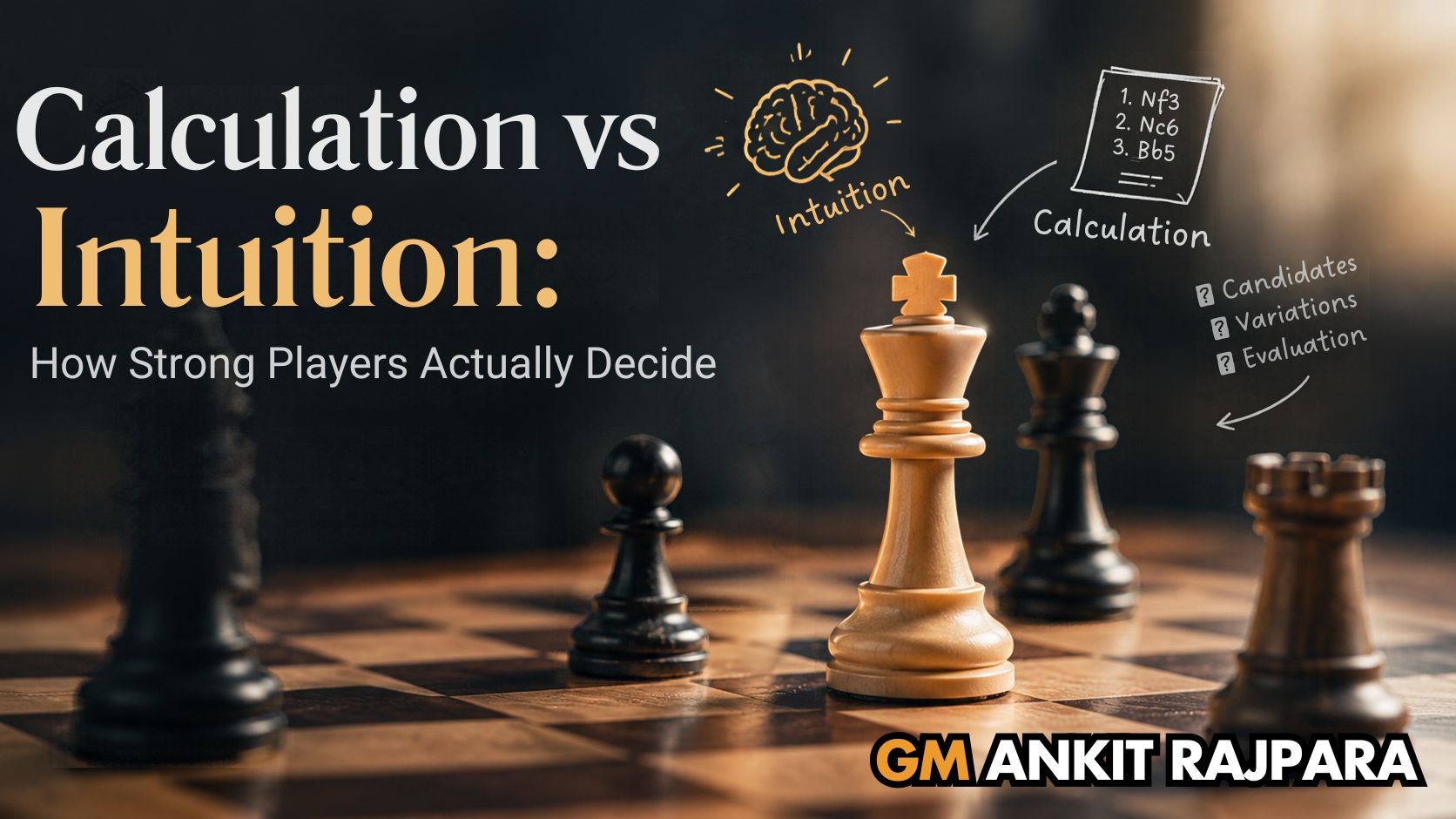
Every chess player has experienced this moment.
You reach a position, notice a promising move, and something tells you it might be right. You can see the idea behind it, perhaps even imagine how the position could develop. But when you start calculating, doubts appear. Your opponent has a defensive resource you hadn't considered, or the variation leads to a position that is harder to evaluate than it first seemed.
So, what should you trust: your intuition or your calculation?
The answer is not as simple as choosing one over the other. Strong players use both, often switching between them several times before making a decision. Intuition helps them recognise possibilities, while calculation helps them determine whether those possibilities actually work.
Understanding how these two skills complement each other can make your thinking more efficient and help you avoid many common mistakes.
What Does Chess Intuition Really Mean?
Chess intuition is often misunderstood as the ability to find good moves without thinking. In reality, it is closely connected to experience and pattern recognition.
After playing and studying thousands of positions, a player begins to recognise familiar features. An exposed king, a badly placed defender, a weak square, or a piece that has no useful role can immediately attract attention.
You may not know the exact variation yet, but you have a feeling that a particular move deserves consideration.
For example, imagine that your opponent's king is exposed and several of your pieces are pointing towards it. You might instinctively look for a sacrifice, even before calculating whether it works.
That instinct comes from recognising a familiar attacking pattern.
The same process happens in quieter positions. An experienced player might notice that a knight would be much stronger on an outpost, that a pawn break could expose a weakness, or that exchanging a particular bishop would make the opponent's position harder to defend.
None of these ideas requires you to calculate ten moves ahead immediately. Your understanding of chess helps you identify what matters in the position.
However, intuition has its limits.
A move can look natural and fit the position perfectly while still allowing a tactical response. A sacrifice may appear promising until you discover that the opponent can return material at the right moment and escape the attack.
Intuition tells you where to look. It does not guarantee that the move works.
Why Calculation Is Still Essential
Calculation is the process of examining concrete variations and determining what happens after both players make their moves.
It becomes particularly important when a position contains forcing moves, tactical opportunities, direct threats, or critical defensive resources.
Suppose you are considering a rook sacrifice against your opponent's king. Your intuition may tell you that opening a file will create dangerous attacking chances. Before playing it, however, you need to investigate the opponent's possible responses.
Can the opponent accept the sacrifice? Is there an intermediate check? Can the king escape? Does the attack lead to checkmate, a winning amount of material, or simply an unclear position?
These questions cannot be answered by the attractiveness of the idea alone.
Good calculation also means considering the opponent's strongest reply rather than the move you hope they will play. A variation is not convincing simply because it works against a passive defence.
This is where many improving players get into trouble. They calculate their own attacking ideas carefully but spend too little time examining how the opponent can resist them.
The result is a variation that looks convincing until the actual game reveals the missing resource.
Calculation provides a reality check. It turns a promising idea into a decision supported by concrete analysis.
How Strong Players Combine Intuition and Calculation
The strongest practical approach is not to separate intuition and calculation completely. Instead, each skill serves a different purpose during the decision-making process.
1. Understand the position before searching for moves
Start by identifying the important features of the position.
Ask yourself a few questions. Which king is less safe? What are the main weaknesses? Which of your pieces are well placed, and which are not contributing much? Is the position mainly about tactics, piece activity, pawn structure, or a potential endgame advantage?
You do not need a perfect evaluation before considering moves. The aim is to establish what the position demands.
If your opponent has an exposed king, attacking moves may deserve attention. If the opponent's pieces are restricted, improving your worst-placed piece might be more effective than forcing a tactical solution.
This initial understanding gives your intuition something useful to work with.
2. Generate a small number of candidate moves
Once you understand the position, identify a few moves worth examining.
These might include a forcing move, a positional improvement, and a move that prevents the opponent's main idea.
You do not need to analyse every legal move. Doing so wastes time and makes it harder to compare the genuinely promising options.
Your intuition can help you narrow the search. Perhaps one move stands out because it improves your worst piece, while another creates a tactical threat.
Keep both in consideration if they have a reasonable justification.
The important point is to generate candidates before committing to one of them. Otherwise, you may spend several minutes proving that your first idea is playable without ever discovering a stronger alternative.
3. Calculate the critical variations
Now examine the moves that could change the evaluation of the position.
When considering a forcing move, begin with checks, captures, and direct threats. But do not treat this as a mechanical checklist that automatically identifies the best move. Quiet moves can be stronger, and defensive moves may be the only way to preserve an advantage.
For each serious candidate, ask what your opponent's strongest response would be.
Continue until you reach a position that you can evaluate with reasonable confidence, or until you discover that the candidate does not work.
You do not always need to calculate a fixed number of moves. Some tactical positions require a long, precise sequence. Others can be understood after only a few moves because the resulting position is clearly favourable or unfavourable.
The goal is not to calculate the longest variation. It is to calculate enough to make a reliable decision.
4. Evaluate the resulting position
Calculation tells you what happens. Evaluation tells you whether you should want that outcome.
Consider a variation in which you win a pawn but allow your opponent to activate both rooks and create a dangerous passed pawn. The material gain may not justify the resulting position.
Similarly, a sacrifice might leave you a piece down but give you a forced attack against the king. In that case, counting material alone would miss the point.
After calculating a line, consider king safety, material, piece activity, pawn structure, and the opponent's counterplay.
This is also where intuition becomes useful again. Experienced players often recognise whether a resulting position is comfortable, dangerous, or difficult to defend.
The process therefore moves back and forth: intuition identifies possibilities, calculation tests them, and evaluation helps you compare the results.
Two Common Mistakes That Weaken Decision-Making
Understanding the relationship between intuition and calculation also helps explain why players sometimes make poor decisions despite having good chess knowledge.
Mistake 1: Trusting a promising idea without checking it
You notice a tactical possibility, become excited about it, and immediately begin calculating how it might win material.
The problem is that you are trying to prove your move works rather than testing whether it works.
You may overlook an intermediate check, a defensive exchange, or a quiet move that neutralises your attack.
The solution is simple in principle: after finding an attractive move, switch perspectives. Ask yourself what you would play if you were defending against it.
Look for the strongest reply, not merely the most natural one. If your idea survives that test, your confidence in it becomes much more meaningful.
Mistake 2: Calculating too many variations without a clear purpose
The opposite problem occurs when a player starts calculating almost every move that looks remotely interesting.
One line leads to another, then another. After several minutes, the player has examined many variations but still cannot explain which candidate is best.
This often happens because the player has not identified the key features of the position or narrowed down the candidates.
Before calculating, establish what you are trying to achieve. Are you looking for a tactical breakthrough? A favourable exchange? A defensive resource? A way to improve your worst piece?
A clear objective makes calculation more focused.
You should still remain open to unexpected moves, but you do not need to explore every possible idea with equal depth.
How to Train Both Skills
Calculation and intuition improve through related but slightly different forms of practice. A good training routine should develop both.
Solve calculation exercises without moving the pieces
Choose positions that require you to find a concrete solution. Calculate the main variations in your head before checking the answer.
Do not stop as soon as you find a plausible first move. Examine the opponent's strongest replies and try to reach a position you can evaluate.
After checking the solution, identify where your analysis went wrong. Did you miss a candidate move, overlook a defensive resource, or lose track of the position during a long variation?
These mistakes tell you more about your calculation than the final score alone.
Study complete master games
Master games help develop intuition because they show how strong players handle positions that are not always decided by tactics.
Try to guess the next move before looking at the game score. Explain to yourself why a move makes sense, what alternatives you considered, and what you expect the opponent to do.
When the played move differs from your choice, compare the ideas rather than simply memorising the correct move.
Over time, this practice helps you recognise recurring positional patterns and generate better candidate moves in your own games.
Review your own critical decisions
Your own games are particularly valuable because you can compare what you thought during the game with what the position actually required.
Find a moment when you spent a long time calculating, played too quickly, rejected a promising move, or missed an opponent's resource.
Reconstruct your thought process before checking an engine. Which candidates did you consider? What variation did you calculate? What assumption influenced your decision?
An engine can help identify tactical errors and stronger alternatives, but understanding why you made the mistake is what makes the review useful for future games.
Practise making decisions under realistic conditions
Training positions without a clock gives you time to explore variations, but tournament chess also requires you to manage your time.
Occasionally solve positions with a realistic time limit. Practise identifying the critical candidates, calculating the important lines, and making a decision without trying to eliminate every uncertainty.
This helps you develop a practical balance between thorough analysis and efficient thinking.
A Practical Thinking Routine for Your Next Game
When you reach a critical position, use the following routine:
1. Understand: Identify the main features of the position and your opponent's threats.
2. Generate: Find two or three serious candidate moves.
3. Calculate: Examine the critical variations and the opponent's strongest responses.
4. Evaluate: Compare the resulting positions, including their risks and practical demands.
5. Verify: Before playing, make one final check for tactical mistakes and overlooked defensive resources.
You will not need to follow every step equally in every position. A forced tactical sequence may demand extensive calculation, while a quiet position may be decided mainly by positional understanding.
The purpose of the routine is not to make thinking mechanical. It is to give your thinking direction, especially when the position is complicated or the clock is running down.
Final Thoughts
The difference between intuition and calculation is not a choice between thinking and guessing. Both are essential parts of strong chess decision-making.
Intuition helps you recognise patterns, understand the position, and discover moves worth considering. Calculation tests those ideas against the opponent's best defence. Evaluation then helps you decide whether the resulting position is actually favourable.
If you rely only on intuition, you risk overlooking concrete refutations. If you calculate without a clear sense of what matters in the position, you can waste time exploring variations that lead nowhere.
The real skill is knowing when to use each ability and how to move between them.
The next time you find an attractive move, don't ask only whether it looks right. Ask why it should work, what your opponent can do about it, and what position will remain when the variation ends.
That is how intuition becomes a sound decision rather than just a promising guess.
If you’d like to explore more positional ideas and practical chess concepts, you can find grandmaster-curated training and explanations on ChessNeurons.
Suggested Related Reading
- Calculation in Chess: How to Navigate Complex Positions — Learn how to systematically evaluate tactical and positional elements in challenging situations.